Last updated: March 2026
If you manage people, one-on-ones are the highest-leverage meeting you run. They raise alignment, catch issues earlier, and strengthen the relationship that ultimately drives performance.
— Gallup
Weekly cadences correlate with ~20% lower anxiety and ~12% higher self-reported success versus less frequent meetings (Reclaim.ai, 2023). Consistency matters: when organizations stopped structured monthly 1:1s, performance deteriorated within ~18 months.
The shape of a great 1:1 is structured but humane: start with a quick personal check-in; review last actions; prioritize the employee’s agenda first; align on priorities; unblock; exchange feedback (both ways); touch career growth periodically; close with clear next steps. The ideal duration is 30–60 minutes depending on cadence and complexity.
For practical techniques on tone, questions, and cadence, see our guide to How to have effective one-on-ones. For 50+ ready-to-use prompts sorted by situation, try One-on-One Meeting Questions for Managers.
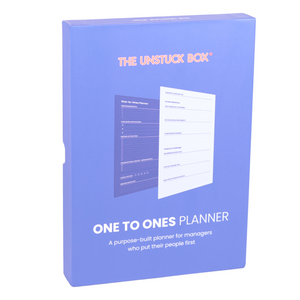
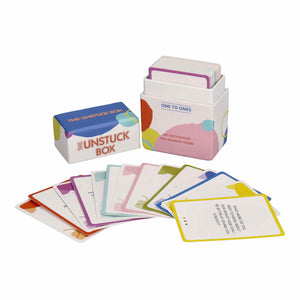
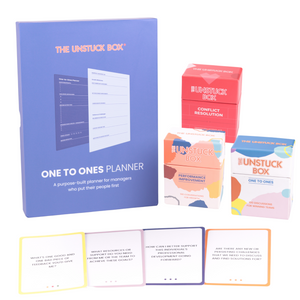
Prefer a tactile, zero-friction option? The Unstuck Box: One to Ones Planner gives you a repeatable structure and high-quality prompts on paper—fast and distraction-free. Or try the One to Ones card deck for conversation prompts you can shuffle and pick from.
Download: 12 Free One-on-One Meeting Templates by Scenario (2026)
All templates are printable and free. Pick the scenario closest to your situation, download the format you prefer, and customize. New for 2026: we’ve added 7 new scenarios plus Excel and Google Sheets formats for templates that work best as trackers.
| Template Name | Best For | Downloads |
|---|---|---|
| 1. The Weekly Check-In | Regular operational alignment and relationship building | PDF DOCX Google Docs |
| 2. New Employee Onboarding | First 90 days with a new team member | PDF DOCX Google Docs |
| 3. Remote / Hybrid Team Member | Virtual one-on-ones requiring extra attention to connection | PDF DOCX Google Docs |
| 4. Career Development Focus | Quarterly or bi-annual development discussions | PDF DOCX Google Docs |
| 5. Skip-Level Meeting | Senior leaders meeting with indirect reports | PDF DOCX Google Docs |
| 6. First 1:1 with a New Report NEW | Your very first one-on-one with someone — covers communication preferences, working style, and expectations | PDF DOCX |
| 7. Monthly Deep-Dive NEW | Longer-form template for monthly cadence or as a supplement to weekly check-ins | PDF DOCX Excel |
| 8. Quarterly Review & Goal-Setting NEW | End-of-quarter reflection paired with next-quarter OKR/goal planning | PDF DOCX Excel |
| 9. Compensation & Promotion NEW | Salary reviews and promotion discussions — fair, evidence-based, forward-looking | PDF DOCX |
| 10. Performance Improvement (PIP) NEW | Structured support when performance needs to improve | PDF DOCX Excel |
| 11. Difficult Conversation NEW | Conflict, sensitive feedback, or personal issues. Based on the HBR framework | PDF DOCX |
| 12. Action Item & Risk Tracker NEW | Lightweight spreadsheet companion for any 1:1 — tracks commitments across meetings | Excel |
How to Schedule Your First One-on-One
Not sure how to kick things off? Here’s a ready-to-send email and calendar invite you can customize.
Email Template: Scheduling Your First 1:1
Subject: Setting up our one-on-one
Hi [Name],
I’d like to set up a regular one-on-one for us — a protected space to talk about priorities, blockers, development, and anything else on your mind. These are your meetings as much as mine.
Logistics I’m thinking:
- Cadence: Weekly, 30–45 minutes
- When: [Suggest 2–3 time slots]
- Where: [Video call / in-person / your preference]
I’ll send a shared doc where we can both drop agenda items before each session. No prep pressure — even “nothing specific this week” is fine.
Let me know what time works best, or if you’d prefer a different cadence to start.
Calendar Invite Template
Title: 1:1 — [Manager Name] ↔ [Report Name]
Description: Our weekly one-on-one. Agenda & running notes: [link to shared doc]
This is your meeting — add anything you’d like to discuss to the shared doc beforehand. If we don’t have agenda items, we can use the time for a quick check-in or cancel for the week.
50+ One-on-One Meeting Questions by Category
Good questions are the engine of a good 1:1. Here are 50+ questions organized by what you’re trying to accomplish. Pick 2–3 per meeting — don’t try to ask them all.
For the full deep-dive (with delivery tips, weak-vs-strong comparisons, and cadence advice), see our companion post: One-on-One Meeting Questions for Managers: 50+ Questions, Sorted by Situation.
Check-In & Rapport
- How are you doing — really?
- What’s been the highlight of your week?
- Is there anything outside of work affecting your focus right now?
- What’s giving you energy lately? What’s draining it?
- On a scale of 1–10, how are you feeling about work this week?
Priorities & Alignment
- What are you working on this week, and how does it connect to our team goals?
- What would you deprioritize if you had to drop one thing?
- Is anything unclear about what success looks like for your current project?
- Where are you spending time that doesn’t feel valuable?
- What decision are you stuck on?
Blockers & Support
- What’s slowing you down right now?
- Is there anything you need from me that you’re not getting?
- What’s one thing I could do differently to help you this week?
- Are there any cross-team dependencies that are creating friction?
- Do you have the tools and resources you need?
Feedback (Both Ways)
- What’s one thing I did well this week as your manager?
- What’s one thing I could improve?
- Here’s something I noticed you did really well: [specific example]. What was your approach?
- I want to share some feedback on [topic] — is now a good time?
- How do you prefer to receive feedback — in the moment, or with some time to process?
Career & Development
- Where do you want to be in 12 months?
- What skills are you most excited to develop?
- Is there a project or responsibility you’d like to take on?
- Who in the company (or industry) do you admire? What about their work appeals to you?
- What’s one thing you’d like to learn this quarter?
Team & Culture
- How’s the team dynamic feeling right now?
- Is there any friction between team members I should know about?
- Do you feel like your contributions are visible and recognized?
- What would make our team meetings more useful?
- Is there anything about our culture that makes your job harder?
Performance & Growth
- Looking back at this quarter, what are you most proud of?
- Where did you fall short of your own expectations?
- What would a successful next quarter look like for you?
- Is there an area where you’d like more honest feedback from me?
- What’s the biggest thing you’ve learned in the last month?
“The scheduled one-on-one is often the main vessel for communication and connection with your manager. Without structure, critical topics fall through the cracks.”
Why Templates Matter
A template isn’t a script. Think of templates as architectural blueprints for meaningful conversation — they provide structure while leaving room for authentic dialogue.
Using a one-on-one meeting template helps managers prepare, stay on track, and document decisions. As we’ve explored in depth, effective one-on-ones require mastering six essential elements — but translating theory into practice requires practical tools.
Gallup’s State of the Global Workplace report consistently shows that employees need to know what’s expected. Templates ensure these critical conversations actually happen rather than getting squeezed out by the crisis of the day.
The Hidden Cost of Unstructured Meetings
When organizations implemented structured monthly one-on-ones, performance improved. When they later stopped (to “save time”), performance deteriorated significantly within 18 months. Structure isn’t bureaucracy — it’s the foundation of sustainable performance.
How to Use These Templates Well
Cadence: weekly > biweekly > monthly. Weekly is ideal. At minimum, never less than monthly. Consistency is the single biggest predictor of 1:1 effectiveness.
If your boss keeps cancelling, don’t give up — see our guide to what to do when your boss keeps cancelling your 1:1s.
The Contrarian View on One-on-One Meetings
Some high-profile leaders minimize one-on-ones altogether, arguing they can devolve into therapy or nitpicking. If you adopt that stance, ensure your alternative creates equal or better mechanisms for coaching, decision velocity, and psychological safety. The evidence still favors well-run 1:1s.
Best Practices for Giving Feedback in One-on-Ones
— Harvard Business Review
Be specific and objective: Focus on concrete examples rather than generalizations.
Balance positive and constructive: Recognize achievements before addressing areas for improvement.
Make it a two-way street: Ask: “What’s one thing I can do to support you better?”
Tie feedback to development: Connect observations to the team member’s career goals.
Follow up: Use your template to track progress and revisit action items in future check-ins.
Building Strong Relationships Through One-on-Ones
One-on-one meetings are more than a time to review tasks — they’re a powerful tool for building trust. When managers dedicate time to meet individually, it signals that contributions and well-being matter.
“Psychological safety — the foundation of high-performing teams — is built in one-on-one conversations, not all-hands meetings.”
— Adapted from Google’s Project Aristotle
Strong relationships built through consistent one-on-ones lead to better collaboration, higher morale, and a more resilient team.
Addressing Diversity and Inclusion in One-on-Ones
One-on-one meetings are a unique opportunity to advance equity within your team. A few ways to make your 1:1s more inclusive:
- Ask about barriers, not just performance. “Is there anything about how our team works that makes it harder for you to do your best work?”
- Check for equal airtime. Are you having the same quality and frequency of 1:1s with every report?
- Adjust communication styles. Some people process out loud; others need time to reflect. Offer to share questions in advance.
- Sponsor, don’t just mentor. Advocate for underrepresented team members in rooms they’re not in.
- Track who gets stretch assignments. Templates with development sections make this visible over time.
Using Technology to Enhance One-on-Ones (Without Killing the Vibe)
For remote 1:1s, technology becomes critical. Nonverbal cues — facial expressions, tone, body language — provide context that’s lost in text or voice alone.
-
Shared doc as source of truth: Use one of the Google Docs templates above. Pin the link to the recurring calendar invite. Maintain a running log so action items roll forward.
Start with a 30-second check-in (energy/clarity), then move to the topics.
Keep action items at the top of the next meeting’s doc.
Lightweight tracker for actions & risks: The Action Item Tracker template (#12) handles this — or use any simple spreadsheet.
Video on (especially remote/hybrid): Non-verbal cues reduce misreads and help you catch friction early.
Pre-read + “one new idea”: Send a brief update before the meeting: What went well / What I’m working on / One new idea.
Paper beats procrastination: The Unstuck Box: One to Ones Planner gives you a tactile flow. The High-Impact 1:1 Playbook is another option for a complete physical system.
Frequently Asked Questions
What is the best format for a 1:1 meeting?
The best format follows a simple structure: quick personal check-in → review prior actions → employee agenda items first → manager topics → feedback exchange → clear next steps. Keep it 30–60 minutes, and maintain a shared running doc so nothing gets lost between sessions. Download our free templates above for ready-made versions.
How often should you have one-on-one meetings?
Weekly is ideal — research shows weekly 1:1s correlate with ~20% lower anxiety and ~12% higher self-reported success compared to less frequent meetings. If weekly isn’t feasible, biweekly is the next best option. Never go less than monthly. Consistency matters more than duration.
How long should a one-on-one meeting be?
30 minutes is the minimum for a meaningful conversation. 45–60 minutes works better for monthly or quarterly sessions, career development discussions, or difficult conversations. Most weekly check-ins fit well in 30 minutes once both parties are used to the cadence.
How do I structure a 1:1 meeting with my manager?
Bring your own agenda — the best 1:1s are employee-led. Share 2–3 topics in advance via a shared doc. Prioritize: blockers and decisions you need help with first, updates second, career/development topics periodically. Don’t wait for your manager to drive the conversation.
What is the 40-20-40 rule for meetings?
The 40-20-40 rule splits meeting time into 40% for the employee’s agenda, 20% for shared topics (priorities, alignment), and 40% for the manager’s items including feedback and development. It’s a useful starting framework, though many effective managers give even more time to the employee’s agenda.
What should I not discuss in a one-on-one?
Avoid using 1:1 time for pure status updates that could be handled asynchronously (Slack, email, project management tools). Don’t use the meeting to micromanage tasks. And avoid saving critical feedback for the 1:1 if it needs to be delivered sooner — urgent issues shouldn’t wait for a scheduled meeting.
Do one-on-one meeting templates actually work?
Yes — with a caveat. Templates improve consistency, preparation, and coverage of important topics. But they work best as flexible frameworks, not rigid scripts. Organizations that implemented structured 1:1s saw performance improve; those that later discontinued them saw performance drop within 18 months.
How should I structure a 1:1 with a new employee?
Focus on building trust, providing orientation, and establishing routines. Use the First 1:1 with a New Report template (#6) and the New Employee Onboarding template (#2) together. Cover communication preferences, expectations, and support needs before diving into task-level detail.
12 free templates get you started. But the best one-on-ones come from better questions — and the Unstuck Box puts 100+ of them in your hands.