Most workplace conversations stay surface-level. People default to project updates, logistics, and polite small talk - not because they don’t care, but because going deeper feels awkward... Unless someone actually asks! Conversation cards solve that problem. They give teams a free pass to talk about things that actually matter: trust, working styles, frustrations, aspirations, and the stuff that turns a group of colleagues into a team that functions well together.
If you’re searching for conversation cards for work, this guide covers the practical questions first: what they are, how managers use them, what separates a useful deck from a gimmicky one, and 40 sample prompts you can use right away.
Short answer: The best workplace conversation cards are built for real manager use cases like standups, one-on-ones, onboarding, offsites, and remote check-ins. Prioritize workplace-specific prompts, clear categories, facilitation guidance, and enough cards to stay fresh over time.
In this guide
What they are • Why they work • How to use them • How to choose a deck • 40 sample questions • FAQ
- Gallup
What Are Conversation Cards for the Workplace?
Conversation cards are decks of question prompts designed to start meaningful discussions between colleagues. Each card contains a question or scenario - you draw one, read it aloud, and the group talks about it. No score, no winner, no PowerPoint. Just better conversation than “how was your weekend?”
The concept has been around for decades in therapy and family contexts, but workplace-specific decks have taken off in the last few years as organizations have realized that team connection isn’t something that happens automatically - especially with remote and hybrid teams where the hallway conversations and lunch-table bonding have largely disappeared.
There are a few broad categories of workplace conversation cards:
Light, fun questions to help people learn about each other. Good for new teams, onboarding, and the first 5 minutes of a meeting. Examples: “What’s one thing you’re irrationally good at?” or “What was your first job?”
Deeper prompts about values, working styles, and personal goals. Designed to build trust over multiple sessions. Examples: “What does support from a teammate look like to you?” or “What’s something you wish your team knew about how you work?”
Prompts specifically for manager-report conversations. Go beyond status updates into career development, feedback, blockers, and motivation. Examples: “What’s one thing I could do differently to support you better?”
Structured prompts for navigating disagreements, giving feedback, and repairing relationships. Not fun in the icebreaker sense - but often the most valuable deck a manager owns. Examples: “What’s one thing we should stop avoiding?”
The best team conversation cards cover multiple categories and let you pick what fits the moment. A Monday standup needs a different kind of prompt than a quarterly offsite.
Why Conversation Cards Work (and Why “Just Talk” Doesn’t)
There’s a reason conversation cards outperform the well-meaning manager instruction to “let’s take 10 minutes to connect before we dive in.” Without a prompt, that instruction produces awkward silence or the same three people dominating with small talk while everyone else checks their phone.
Conversation cards for work solve three problems simultaneously:
1. They remove the social risk of going first. Asking “what’s something you’re struggling with at work?” is hard to say out loud to your team. But reading it off a card? That’s different. The card asked, not you. This small layer of indirection lowers the psychological barrier to vulnerability - which is exactly what trust is built on.
Google’s Project Aristotle found that psychological safety was the most important dynamic in effective teams. In the same guide, Google cites Amy Edmondson’s definition of team psychological safety as “a shared belief held by members of a team that the team is safe for interpersonal risk taking.”
2. They equalize participation. In most meetings, extroverts talk and introverts wait. Cards create a natural turn-taking structure - someone draws, everyone responds. That gives managers a more accurate read on the team instead of hearing only from the loudest voices.
3. They create consistency. One team-building exercise at the annual offsite is not a culture strategy. It’s an event. Cards can be used weekly - five minutes at the start of a standup, a round at lunch, one question per one-on-one. That consistency is what builds real trust, not the ropes course.
- Gallup
8 Ways to Use Conversation Cards at Work
Cards are versatile, but context matters. Here’s how to deploy them in different scenarios - with the right deck type and facilitation approach for each.
1. Weekly Team Standups & Huddles
Format: One card, drawn at random, answered by each person in 30–60 seconds before you move into the agenda.
Best card type: Icebreakers and light team-building prompts. Keep it fun - this isn’t the time for deep vulnerability. Questions like “What’s something you’ve learned recently that surprised you?” or “What’s the best meal you had this week?” are right for the tone.
Why it works: It takes 3–5 minutes and transitions the group from “I was just on another call” mode to “I’m present with this team.” Over months, you’ll be surprised how much these small moments compound into genuine familiarity.
2. One-on-One Meetings
Format: Pick one card from a coaching-style deck to open or close the conversation. Alternate who picks.
Best card type: Manager coaching and career development prompts. Questions like “What’s the most useful feedback you’ve ever received?” or “What part of your role energizes you most right now?”
Why it works: One-on-ones often slide into project status updates. A single card prompt redirects the conversation toward the things that actually build the manager-report relationship: trust, growth, and alignment. For a deeper dive on running effective one-on-ones, see our guide to how to have effective one-on-ones.
If you want the manager-specific version of this idea, our leadership conversation starters guide shows how to choose one question, set context, wait, and follow up without turning the moment into an interview.
3. New Employee Onboarding
Format: 10–15 minutes during the new hire’s first team meeting. Each existing team member draws a card and answers, then the new person gets a turn.
Best card type: Get-to-know-you and working-style prompts. “How do you prefer to receive feedback?” “What does a good day at work look like for you?” “What’s a skill you have that most people here don’t know about?”
Why it works: New hires learn more about team dynamics in 15 minutes of card prompts than in a week of sitting in on meetings. And existing team members get a reminder of each other’s working styles - something that’s easy to forget over time.
4. Team Offsites & Retreats
Format: Longer sessions (30–60 minutes) with deeper prompts. Pairs, small groups, or full-team rounds. Mix in some lighter prompts to keep the energy varied.
Best card type: Team building, values, and working-style prompts. This is the context where you can go deeper: “What’s something you wish this team did differently?” “What’s the biggest risk you’ve taken in your career?” “Describe a team you’ve been on that worked really well - what made it work?”
Why it works: Offsites are an investment of time and money, but too many of them end up being extended status meetings in a nicer room. Cards provide the structured prompts that turn “team-building time” from a vague agenda item into something that actually produces connection.
5. Remote & Hybrid Team Check-ins
Format: One card per video call, with each person unmuting to answer. Or post a card prompt in Slack/Teams and have people respond asynchronously.
Best card type: A mix of icebreakers and connection-building prompts. Remote teams need more deliberate relationship investment than in-office teams because the spontaneous watercooler moments don’t happen.
Why it works: Gallup has found that employees who work remotely 100% of the time can feel isolated and disconnected because they miss natural opportunities to connect with coworkers and the organization. Structured conversation prompts help managers replace some of that lost social glue with something deliberate and repeatable (Gallup).
Remote team tip: Don’t force cameras on for card rounds. Some people share more freely when they’re not performing for a camera. And consider async card prompts in a Slack channel - introverts often write richer answers than they’d give live.
6. Conflict Resolution & Difficult Conversations
Format: One-on-one or small group (2–4 people). Select cards that address the specific dynamic - feedback, expectations, communication breakdowns. Allow more time per question.
Best card type: Conflict resolution and feedback-focused prompts. “What’s one thing about how we communicate that could work better?” “When you feel frustrated at work, what does that usually look like from the outside?” “What’s an assumption you’ve been making that might be wrong?”
Why it works: Most people avoid difficult conversations because they don’t know how to start them. A card makes the opening move for you. It shifts the dynamic from confrontation (“I need to talk to you about something”) to exploration (“here’s an interesting question - what do you think?”). For more on this, see our guide to workplace conflict resolution.
7. Leadership Development & Training Workshops
Format: Integrate card prompts into workshop segments. Use them as discussion starters after a teaching module, or as reflection prompts at the end of a session.
Best card type: Coaching and leadership-focused prompts. “What’s the hardest feedback you’ve ever had to deliver?” “How do you decide when to step in and when to let someone figure it out?”
Why it works: Workshops that are all lecture and no discussion are easy to forget. Card prompts force participants to apply concepts to their own experience in real time, which is where the actual learning happens.
8. Cross-Functional & Inter-Team Meetings
Format: Open with a round of icebreaker cards when people from different teams are meeting for the first time or working on a joint project.
Best card type: Light icebreakers and working-style prompts. “What’s one thing your team does that you think every team should do?” “What’s the best collaboration you’ve been part of - what made it work?”
Why it works: Cross-functional teams often skip the relationship-building phase entirely because everyone assumes the other team already has their own culture. Cards bridge that gap fast.
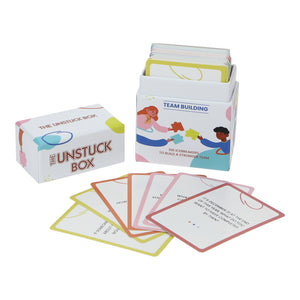
Comparing deck options? Prioritize workplace-specific prompts, clear categories, enough cards to stay fresh, and facilitation guidance for managers who are not trained facilitators. The Unstuck Box: Team Building deck has 100 prompts across 8 categories - from light icebreakers to deeper working-style questions. For one-on-one conversations, the One to Ones deck has 100 coaching prompts organized by situation. Both decks have a question on the front and facilitation guidance on the back of every card.
How to Choose the Best Conversation Cards for Work
There are a lot of workplace conversation card products on the market now, and the quality varies wildly. Some are genuinely useful tools. Others are novelty gifts that get used once at a team lunch and then live in a drawer forever. Here’s what separates a deck that keeps getting used from one that gets forgotten:
Range and depth of questions. A good deck has a mix of light, medium, and deep prompts so you can match the card to the moment. All-icebreaker decks get stale fast. All-deep decks feel too intense for a Monday morning. Look for decks that are organized by category or difficulty level so you can grab the right card without sorting through the whole deck.
Workplace-specific, not generic. Generic conversation cards (“What’s your favorite vacation?”) are fine for dinner parties but miss the mark at work. The best workplace decks have prompts that are specifically designed for professional contexts - questions about feedback, communication styles, collaboration, career development, and team dynamics. These are the conversations that actually improve how a team works together.
Guidance on the cards. The best decks don’t just give you a question - they give you context. A prompt that says “What motivates you?” is fine, but a card that says “What motivates you?” on the front and provides follow-up suggestions, facilitation tips, or context on why this question matters on the back is far more useful, especially for managers who are still building their coaching skills.
Physical quality that signals respect. This sounds superficial, but it matters. If you pull out a deck of flimsy, poorly printed cards, the team reads that as “my manager printed these off the internet during lunch.” A well-designed, sturdy deck signals that you’ve invested in this - which gives the activity more weight and makes people take it more seriously.
Enough cards to last. If you’re using one card per week in a standup, a 52-card deck lasts exactly one year. If you’re using them in one-on-ones with 5 reports, you’ll burn through that deck in 10 weeks. Do the math on your use case and make sure the deck has enough prompts to stay fresh.
40 Sample Conversation Card Questions for Work
To give you a sense of what good conversation card prompts look like, here are 40 questions organized by category and situation. Use these as-is in your next meeting, or use them to evaluate whether a conversation card deck you’re considering covers the right ground.
Icebreakers & Warm-ups
| # | Question | Best For |
|---|---|---|
| 1 | What’s something you’ve changed your mind about recently? | Standups |
| 2 | What’s a skill you have that doesn’t show up in your job description? | Standups |
| 3 | If you could swap roles with anyone on the team for a day, who would it be and why? | Standups |
| 4 | What’s the best piece of career advice you’ve ever received? | Standups |
| 5 | What’s one thing you’d want a new teammate to know about you? | Onboarding |
Team Building & Trust
| # | Question | Best For |
|---|---|---|
| 6 | What does “support” from a teammate look like to you? | Offsites |
| 7 | What’s something this team does well that you don’t think we give ourselves enough credit for? | Offsites |
| 8 | Describe a time when you felt genuinely proud of something this team accomplished. | Offsites |
| 9 | What’s something you wish your team knew about how you work best? | Onboarding |
| 10 | What’s the most important lesson you’ve learned from a team that didn’t work well together? | Offsites |
| 11 | How do you prefer to celebrate a win - publicly or privately? | Standups |
| 12 | What makes you trust someone at work? | Offsites |
One-on-One & Manager Coaching
| # | Question | Best For |
|---|---|---|
| 13 | What’s the most useful piece of feedback you’ve ever received? | 1:1s |
| 14 | What part of your role energizes you the most right now? | 1:1s |
| 15 | If you could spend 20% of your time on anything work-related, what would it be? | 1:1s |
| 16 | What’s one thing I could do differently to make your work easier? | 1:1s |
| 17 | Where do you want to be in your career a year from now, and what’s one thing we could do to help you get there? | 1:1s |
| 18 | What’s something you’ve been putting off that we should talk about? | 1:1s |
| 19 | When was the last time you felt truly challenged by your work - in a good way? | 1:1s |
For 50+ more manager-specific conversation prompts organized by situation, see our guide to one-on-one meeting questions for managers.
Conflict Resolution & Feedback
| # | Question | Best For |
|---|---|---|
| 20 | What’s one thing about how we communicate as a team that could work better? | Feedback |
| 21 | How do you prefer to receive difficult feedback - directly, in writing, or with time to process first? | Feedback |
| 22 | What’s one assumption you’ve been making about this project (or this person) that might be wrong? | Feedback |
| 23 | When you feel frustrated at work, what does that usually look like from the outside? | Feedback |
| 24 | What’s something we keep avoiding as a team? | Feedback |
| 25 | What would it look like if we disagreed well on this team? | Feedback |
Remote & Hybrid Connection
| # | Question | Best For |
|---|---|---|
| 26 | What does your workspace look like right now? (Bonus: show us.) | Remote |
| 27 | What’s one thing about working remotely that you’ve come to appreciate that you didn’t expect? | Remote |
| 28 | If our team had a theme song, what would it be? | Remote |
| 29 | What’s one non-work thing you’ve gotten into recently? | Remote |
| 30 | What’s the hardest part of collaborating with people you don’t see in person? | Remote |
Career Development & Growth
| # | Question | Best For |
|---|---|---|
| 31 | What’s a skill you’d love to develop but haven’t had the chance to yet? | 1:1s |
| 32 | Who in this organization (or outside it) do you admire, and what would you want to learn from them? | 1:1s |
| 33 | What would your ideal role look like three years from now? | 1:1s |
| 34 | What’s a recent project where you felt like you were really in your element? | Offsites |
| 35 | What’s one thing this organization could do better at developing its people? | Offsites |
Values & Culture
| # | Question | Best For |
|---|---|---|
| 36 | What’s one company value that you think we live well, and one we need to work on? | Offsites |
| 37 | What’s the unwritten rule on this team that a new person wouldn’t know about? | Onboarding |
| 38 | When do you feel most “yourself” at work? | Offsites |
| 39 | What’s one thing about this team’s culture you’d want to protect as we grow? | Offsites |
| 40 | If you could change one thing about how meetings work here, what would it be? | Standups |
Want 300 more questions like these? The Unstuck Box card decks - Team Building, One to Ones, and Conflict Resolution - each contain 100 professionally crafted prompts with facilitation guidance on the back of every card. Pair them with the One to Ones Planner for a structured note-taking system, or try the digital app for instant access to nearly 1,000 prompts across all decks.
How to Facilitate a Conversation Card Session (Without It Feeling Forced)
The single biggest reason conversation cards fall flat isn’t the cards - it’s the facilitation. Here’s how to run a session that people actually enjoy.
Before the Session
Pre-select 5–8 cards. Don’t hand someone the full deck and say “pick one.” That creates decision paralysis and lets people cherry-pick safe questions. Pre-selecting cards means you can match the depth to the group’s readiness. For a new team, lean lighter. For a team that’s been together for years and needs to break out of a rut, go deeper.
Choose the right moment. Conversation cards work best when people aren’t already mentally loaded. The start of a meeting (before the agenda kicks in), the first evening of an offsite, or the end of a sprint retro are all good timing. The middle of a crisis or right after a layoff announcement? Not the time.
Brief the group in advance if it’s their first time. A simple “we’re going to open with a quick round of conversation cards - just a fun way to connect before we start” is enough. Don’t oversell it. Don’t call it a “team-building exercise.” Just frame it as part of the meeting.
During the Session
Go first. The facilitator (usually the manager) should answer the first question. This sets the tone for vulnerability. If you give a surface-level answer, everyone else will too. If you share something real, you give permission for the group to do the same.
Enforce “pass is fine.” Say it out loud before the first card: “If a question doesn’t land for you, just say pass - no explanation needed.” This makes the whole exercise safer, and ironically, people almost never pass when they know they can.
Resist the urge to debrief every answer. The biggest facilitation mistake is turning every response into a coaching moment. Let people’s answers land. A nod, a “thanks for sharing that,” and moving to the next person is usually better than “that’s really interesting, tell me more about that.” Save the deeper exploration for one-on-one follow-ups.
Watch the clock. For standup icebreakers, 1 card, 30 seconds per person, done. For offsite deeper sessions, 3–5 cards over 30–45 minutes. Don’t let it drag. Ending while people are still engaged is much better than ending when people start checking their phones.
After the Session
Follow up individually. If someone shared something interesting or vulnerable, mention it to them later - privately, casually. “That thing you said about wanting more challenge - I’ve been thinking about that. Can we talk about it in our next 1:1?” This is how a 5-minute card exercise turns into a genuine shift in your team dynamic.
Repeat consistently. One session doesn’t change a culture. Weekly standup icebreakers, a card round at the start of every one-on-one, a deeper session at each quarterly offsite - that cadence is what produces results. Think of conversation cards for work less as an event and more as a habit.
Conversation Cards vs. Other Team-Building Tools
Conversation cards aren’t the only way to build team connection, but they have specific advantages over the alternatives:
| Tool | Strengths | Limitations |
|---|---|---|
| Conversation Cards | Zero prep, works for 2–200 people, adaptable to any context, reusable weekly, works remote or in-person | Requires a willing facilitator; some people are skeptical at first |
|
Personality Assessments (MBTI, DISC, StrengthsFinder) |
Structured frameworks for understanding work styles; gives shared vocabulary | One-time event; expensive; can create rigid labels; doesn’t build ongoing connection |
|
Team-Building Events (Escape rooms, cooking classes) |
Memorable shared experiences; fun; breaks routine | Expensive; logistically complex; effects fade quickly; not repeatable weekly; excludes remote workers |
|
Engagement Surveys (Gallup Q12, Officevibe) |
Data-driven; tracks trends over time; anonymous | Measures sentiment but doesn’t build connection; survey fatigue; lagging indicator |
|
SaaS 1:1 Tools (Lattice, 15Five, Culture Amp) |
Integrated with performance management; tracks action items; automated nudges | $$$ per seat; screen-based (another tool to log into); conversations can feel transactional |
The best approach is usually conversation cards plus one or two of the above, not instead of. Cards are the daily habit; assessments and events are the quarterly or annual punctuation marks.
For a broader comparison of card-based team tools, see our ranked guide to the 15 best team building card games for work.
Common Mistakes (and How to Avoid Them)
Making it mandatory. “Everyone must answer every card” kills psychological safety faster than anything. Make it opt-in with a low social cost to participate - and watch how quickly participation becomes universal once people see it’s not a trap.
Going too deep too fast. If your team has never done conversation cards before, do not start with “What’s your biggest fear about this team?” Start with “What’s the best thing you ate this week?” and work your way up over several sessions. Trust is built incrementally.
Using them as a diagnostic tool. If you start treating card responses as data (“interesting that three people said they don’t feel supported - let’s dig into that in a meeting”), people will stop being honest. Cards are for connection, not surveillance.
Only using them at offsites. Annual or quarterly use is better than nothing, but the real value comes from consistent, low-dose application. One card per week beats a 2-hour session once a year.
Choosing a deck without facilitation support. A card that just says “What motivates you?” is fine for experienced facilitators. But most managers aren’t trained facilitators. Look for decks that include follow-up suggestions, context, or guidance on the back of each card - it makes the difference between a flat exchange and a real conversation.
Frequently Asked Questions
How many conversation cards do I need for a workplace team?
It depends on how often you plan to use them. For weekly standup icebreakers with one card per meeting, a 52-card deck lasts a year. For one-on-one meetings with 5 direct reports using one card per session, you’ll go through a 100-card deck in about 20 weeks. Most workplace decks contain between 50 and 200 cards - aim for at least 100 if you plan to use them regularly.
Do conversation cards work for remote teams?
Yes, and remote teams arguably need them more than co-located teams. You can read a card aloud on a video call, post a daily prompt in a Slack or Teams channel, or use a digital conversation card app. The key for remote teams is consistency - a quick card prompt at the start of every video standup creates familiarity that remote workers don’t get from hallway conversations.
What’s the difference between conversation cards and icebreaker questions?
Icebreakers are a category within conversation cards - they’re the light, get-to-know-you prompts. But good workplace conversation card decks go much further, covering coaching, feedback, conflict resolution, career development, and team dynamics. Think of icebreakers as the shallow end of the pool - you start there, but the real value is in the deeper water.
Are conversation cards appropriate for all workplace cultures?
Nearly all, with the right calibration. More reserved or formal cultures (legal, finance, government) may need lighter, more professional prompts to start. Informal startup cultures can jump to deeper questions faster. The key is matching the deck and facilitation style to your team’s comfort level and building from there. Always make participation voluntary, especially in cultures where vulnerability is less normalized.
Can I make my own conversation cards?
You can, but there are tradeoffs. DIY cards are free and customizable, but most people underestimate how hard it is to write questions that are specific enough to spark real conversation without being too personal or too bland. Professionally designed decks usually give you stronger category coverage, tighter wording, and fewer dead questions than a first DIY draft. If budget allows, start with a professional deck and supplement with custom questions specific to your team.
How often should we use conversation cards with our team?
Weekly is the sweet spot for most teams. One card at the start of a standup or team meeting takes 3–5 minutes and compounds into real familiarity over months. For one-on-ones, one card per session (weekly or biweekly) is effective. Quarterly offsites are a good time for deeper, longer card sessions of 30–60 minutes. The goal is consistency rather than intensity - small doses, often, beat big sessions rarely.
What if my team thinks conversation cards are cheesy?
This is the most common concern, and it’s almost always overblown. The skeptics are usually the first people to get into it once they see the questions aren’t “what’s your spirit animal?” Choose a deck with sophisticated, workplace-relevant questions. Don’t call it “team building.” Just say “we’re going to start with a quick question before we get into the agenda” and go. After two or three sessions, the skeptics typically become the biggest advocates.
Physical cards vs. digital - which is better for workplace use?
Both have their place. Physical cards work better for in-person meetings - the tactile act of drawing a card from a deck creates a moment of anticipation and makes the activity feel distinct from the rest of the screen-heavy workday. Digital cards are essential for remote teams and have the advantage of being always available. Many teams use physical cards for in-office meetings and a digital app for remote standups and async prompts. If you can only choose one, match it to where your team spends most of its time.
Ready to try conversation cards with your team?
The Unstuck Box makes conversation cards specifically for managers and team leaders - with 100 prompts per deck, facilitation guidance on every card, and categories organized by situation. Trusted by 50,000 leaders globally.
Team Building Cards One to Ones Cards Conflict Resolution Cards